

· AFX Research
Chain of Title to 1940 or to 1980, Choosing the Search Depth
Why 1980 and 1940 are the two dates that matter in environmental due diligence, what each one is tied to, and how extra depth changes the cost and the turnaround of a search.
Table of Contents
Two dates come up over and over in environmental due diligence, and clients often ask for one when the assessment actually calls for the other. A chain of title report can run 50 years, 60 years, back to 1940, or back to 1980, and those are not interchangeable settings on the same dial. Each is attached to a different requirement, and one of them is written into a standard while the others come from practice.
Four depths, four different reasons
The depth you order determines how far back through the grantor and grantee index a researcher walks, and therefore how many owner names get run through every repository in scope.
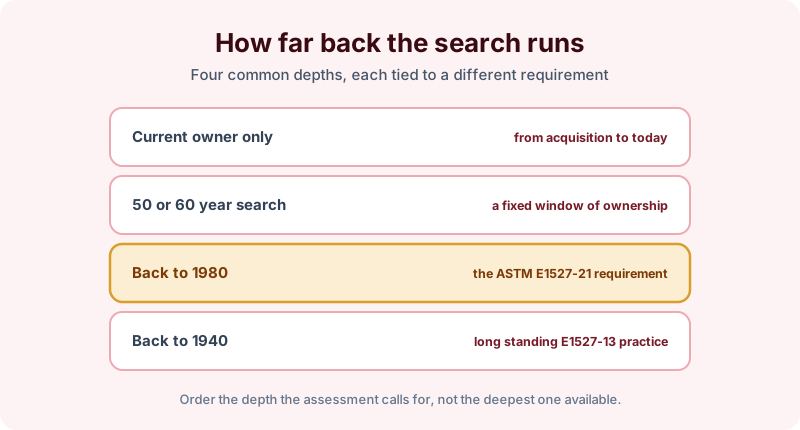
A current owner search runs from the date the present owner acquired the property to today. That was standard practice for environmental lien work for years, and it is still what the ASTM E1527-13 report covers. The fixed window searches, 50 and 60 years, are common in commercial transactions for reasons that have nothing to do with environmental standards.
Where 1980 comes from
1980 is the year CERCLA was enacted. That is the entire reason it is the date in the standard. No federal environmental lien arising under CERCLA can predate the statute that created the mechanism, so a search that reaches 1980 reaches the beginning of that category of encumbrance.
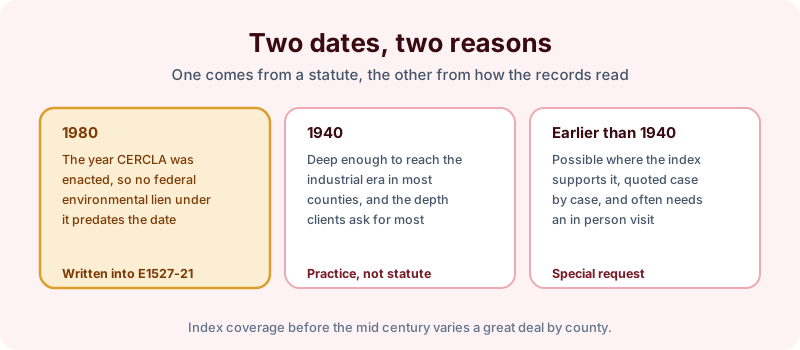
When ASTM revised the standard in 2021, the lien and AUL section is where the most consequential change landed. Under ASTM E1527-21, the land records are searched back to 1980 rather than back to the current owner’s acquisition date. Our 1980 Environmental Lien and AUL report is built to that requirement and includes the chain of title to 1980 and a copy of the current deed.
Where 1940 comes from
1940 is not in any statute. It is the depth most clients request to satisfy the guidance described in section 8.3.2 of the E1527-13 standard, and it persists because it is deep enough to reach the industrial era in most counties. A parcel that was a rail yard, a foundry, or a fuel depot in the 1940s and 1950s is exactly the kind of history a 1940 chain surfaces and a 40 year window would miss.
Searches earlier than 1940 are possible where the index supports them. They get quoted case by case, because index coverage before the middle of the century varies a great deal from one county to the next, and a pre 1940 search frequently means someone working through bound books at a counter.
What extra depth actually costs
It is tempting to order the deepest search available on the theory that more is safer. It is worth understanding what you are buying.
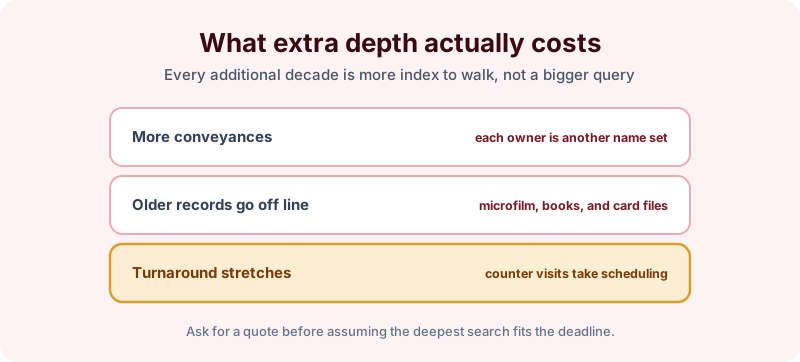
A deeper chain is not a bigger database query. Each additional owner in the chain is another name set to run through every index in scope, and the further back the search reaches the more likely those records sit on microfilm or in bound volumes rather than in a searchable system. Depth costs days as well as dollars. Chain of title reports are generally completed within 5 business days, and a deep chain in a county with thin digital coverage sits at the far end of that range.
Matching the depth to the requirement
The practical rule is to order what the assessment is written to rather than the deepest option on the list. If the assessment cites E1527-21, the search runs to 1980. If it cites E1527-13 and the scope calls for ownership history, 1940 is the depth clients most often name. If you are not sure which applies, the FAQ covers how the chain research is performed, and a title representative can size it with you.
The takeaway
The two dates answer different questions. 1980 is a requirement written into E1527-21 because it is when CERCLA created the lien mechanism. 1940 is a practice that reaches back far enough to catch the industrial history that matters on most sites. Ordering more depth than the assessment calls for buys days you may not have. Start the order online, or send us the property details and the standard you are working to and we will tell you what each depth would and would not cover before anything is ordered.