

· AFX Research
What an Environmental Lien and AUL Search Cannot Tell You
The line between a records search and a site investigation, the four honest gaps in any public record, and what to do when a lien or AUL actually turns up on a parcel.
Table of Contents
A good environmental lien report is precise about its own boundaries, and reading one well means knowing where those boundaries sit. Every AFX report lists the locations researched for exactly this reason. This is a plain account of what a records search does not cover, written by the people who produce the searches, because a reviewer who misreads the scope is worse off than one who never had the report.
A search reads paperwork, not soil
The most common misreading treats a clean lien report as evidence that a property is clean. Those are different claims about different things.
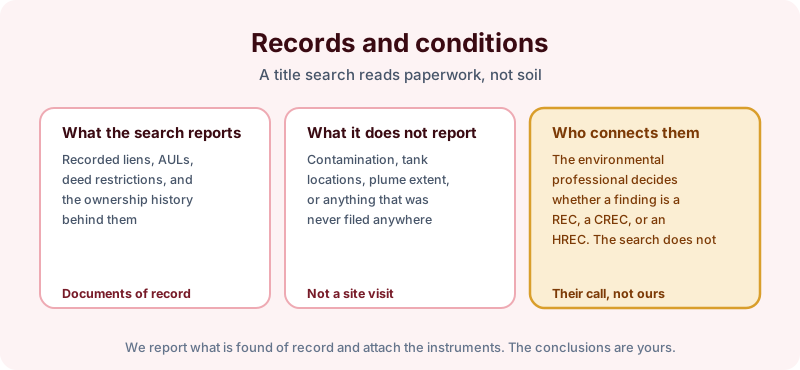
An environmental lien and AUL search reports recorded liens, Activity and Use Limitations, deed restrictions, and the ownership history behind them. It says nothing about contamination, tank locations, or plume extent, because none of those are documents. The connection between a recorded finding and a site condition is a judgment, and it belongs to the environmental professional preparing the assessment rather than to the abstractor who found the filing.
Four gaps in the record itself
Even inside its own scope, a public record search has limits that no amount of care removes.
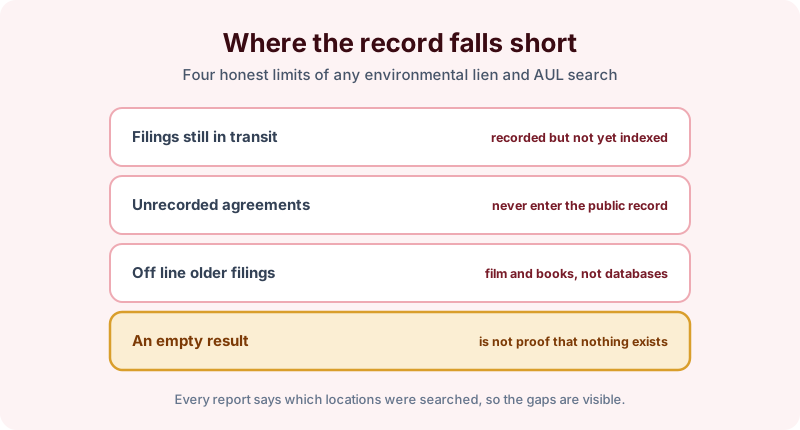
Filings in transit have been recorded but not yet indexed, so they are invisible to a search run today and visible to one run next month. Unrecorded agreements between private parties never enter the record at all. Older filings frequently sit on microfilm or in bound books rather than in a searchable system, and how far back the digital index reaches varies a great deal from one county to the next.
The fourth is the one to say out loud. An empty result means nothing was found of record in the locations searched. It is not proof that nothing exists. Recording and indexing practice varies by county, and neither environmental liens nor AULs are common to begin with, which makes a clean result unsurprising rather than conclusive.
Scope is set by the standard, not by the search
A report covers the window it was ordered for. A current owner search under E1527-13 covers from the current owner’s acquisition to today and does not reach the 1970s, no matter how thorough it is within its window. If the assessment is written to E1527-21, the 1980 report is what covers that requirement, and our comparison of the two standards sets out the difference. Ordering the narrower search and expecting the wider answer is a scoping mistake rather than a search failure.
When something does turn up
AULs are more prevalent than environmental liens, and when found they often exist within deeds. Either way, a hit is the start of a review rather than the end of one.
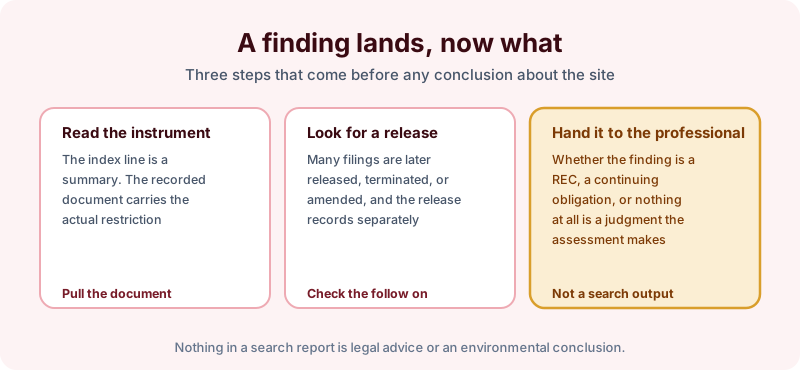
Read the recorded instrument rather than the index line, because the index summarizes and the document carries the actual restriction. Check whether a release, termination, or amendment was recorded later, since many filings are resolved and the resolution records separately. Then hand the documents to the person whose judgment the file depends on. Whether a finding is a Recognized Environmental Condition, a continuing obligation, or nothing of consequence is decided in the assessment, not in the search report.
Why the limits are worth stating
Reports that overclaim are more dangerous than reports that are careful, because a reviewer relies on the claim. Saying that every lien and AUL found of record is documented, and listing where the search went, gives the assessment something defensible to cite. Our sample reports show how that scope statement reads in a finished document, and the FAQ covers the repositories the standard names.
The takeaway
An environmental lien search tells you what has been recorded in the places it searched, over the window it was ordered for, and it attaches the documents. It does not describe the site, it does not reach filings that never entered a public record, and an empty result is not a clean bill of health. Start the order online, or send us the property details and we will tell you what a search of that scope would and would not cover before anything is ordered.