

· AFX Research
Where Environmental Liens Are Recorded Beyond the Property Index
The three families of record an environmental lien can sit in, why the recorder office alone is not enough, and what a good faith search across all of them looks like.
Table of Contents
If you have ever run a conventional lien search, the mechanics feel familiar. You go to the county recorder, you search the grantor and grantee index, you pull what comes back. An environmental lien and AUL search starts the same way and then keeps going, because the records that count as environmental liens are scattered across offices that have nothing to do with each other. That scattering is the whole reason this is a specialty search rather than a line item on a standard title order.
The recorder office is one source of three
Conventional real estate liens have a recording and indexing mechanism that is relatively uniform across jurisdictions. A mortgage gets recorded, it gets indexed, and anyone who knows the owner name or the parcel can find it. Environmental encumbrances are not that tidy. The types of records that can be classified as an environmental lien come in a wide variety and are recorded in dozens of dissimilar manners.
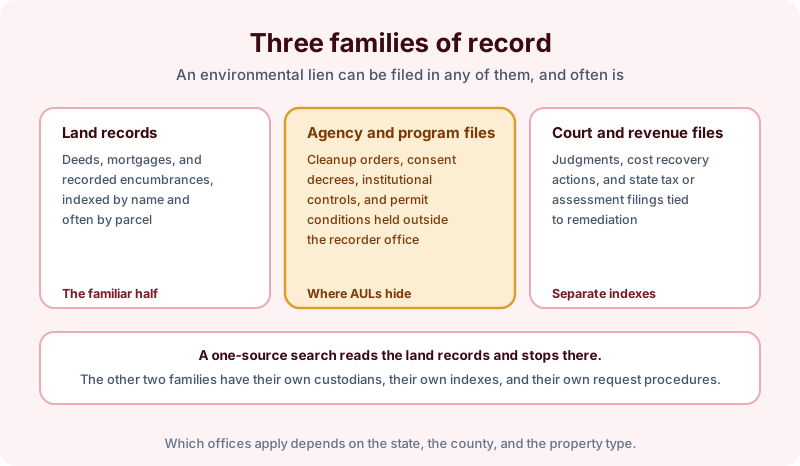
The land records are the familiar half. The other two families are the reason a one source search is not enough. Cleanup orders, consent decrees, institutional controls, and permit conditions frequently live with the agency that issued them. Cost recovery actions and remediation related assessments live with courts and revenue departments. Each has its own custodian, its own index, and its own request procedure.
Why the sources moved
Originally an environmental lien was a straightforward financial record, a debt matching a property owner’s obligation to correct environmental damage. A specified dollar amount in response to a spill, sized to the cost of putting the property back the way it was.
Since the ASTM standard arrived in 2005 and became a requirement in 2006, many other kinds of remedial record have been issued as environmental liens and AULs. Agencies recognized that these filings get scrutinized during a financing or a transfer, which made them an effective way to advance an interest. Issues that were once ignored for lack of an enforcement mechanism now get filed under the environmental lien umbrella. The practical result is that the set of places worth searching grew, and it kept growing.
What varies once you leave the recorder
Nothing about the second and third families is standardized nationally. The office that holds a filing in one state holds nothing in the next.
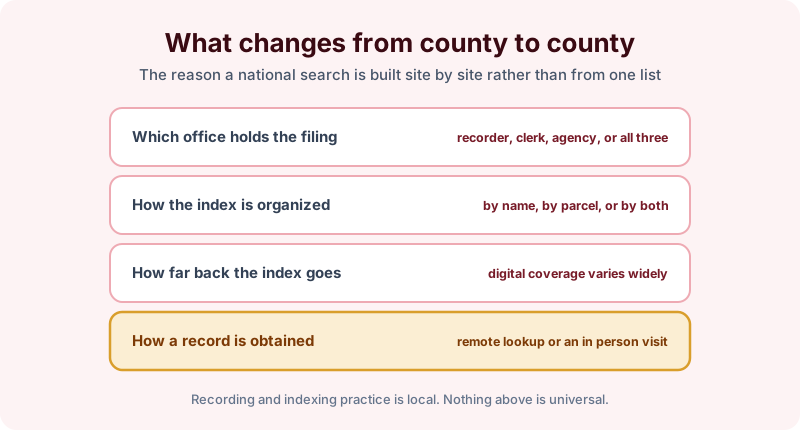
Section 4.6 of the ASTM E1527-13 standard names the categories, federal, tribal, state, and local government records, and stops there. It does not tell you which office in Cuyahoga County holds what. That mapping is built site by site, and it is the part that takes decades to accumulate rather than an afternoon to look up.
What a good faith effort actually requires
Because there is no single index, searching for these records requires a good faith effort to locate them in the various places they may be. In practice that breaks into three moves.
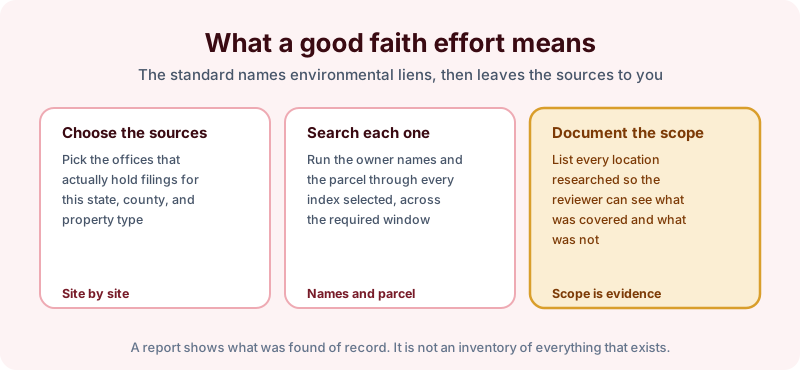
The third move is the one reviewers care about most. Every AFX report carries a list of all locations researched to complete it, which is what lets a reviewer see the boundary of the search rather than guess at it. You can see how that reads in a finished document on our sample reports page.
A search reports what was found of record. It is not an inventory of everything that exists, and an empty result does not prove that a property is clean. Recording practice varies by county, some filings never reach a public index at all, and the judgment about what any finding means for the site belongs to the environmental professional preparing the assessment.
The takeaway
Environmental liens are no longer found only within the property records index, so a search that stops at the recorder office is answering a narrower question than the standard asks. Which offices apply depends on the state, the county, and the property type, and getting that list right is most of the work. Start the order online, or send us the property details and we will tell you which repositories a site of that kind pulls in before anything is ordered. If you are still deciding how far back the search has to run, our guide to choosing the chain of title depth covers that next.