

· AFX Research
Where the Lien and AUL Search Fits in All Appropriate Inquiries
The separate inquiries that make up AAI, the one piece a title abstractor actually performs, and how the search window and the finished report get used by the environmental professional.
Table of Contents
Most people ordering an environmental lien search are doing it because a checklist told them to, which works perfectly well until somebody asks what the line item is for. All Appropriate Inquiries is the frame that put it there. This is a plain account of what that frame contains, which part a title abstractor supplies, and what happens to the report once it arrives.
The inquiry is a bundle, not one search
All Appropriate Inquiries is the standard of investigation sitting underneath a Phase I Environmental Site Assessment, and it is satisfied by a set of separate inquiries rather than by any single document.
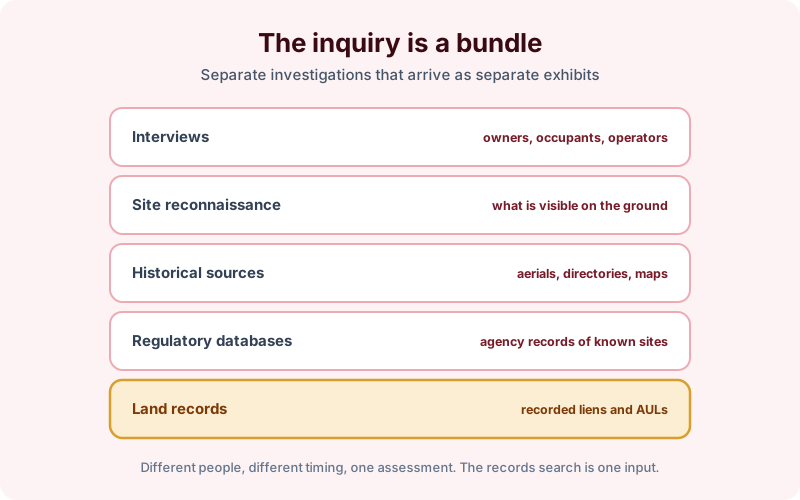
Interviews, a site reconnaissance, a review of historical sources, a look at regulatory databases, and a search of the land records for environmental liens and Activity and Use Limitations. They are performed by different people, at different times, and they land in the assessment as different exhibits. The records search is one input among several rather than the whole of the inquiry.
The piece a records search supplies
What an abstractor contributes is the land records component, and it is narrower than the phrase sometimes implies. The search reports recorded environmental liens and AULs, with the chain of title behind them, and attaches the instruments. The chain travels with it because the ownership history is what tells you whose name to search under, and a filing made against an owner three deeds back is still attached to the parcel today. It does not touch the site, the databases, or the interviews. That division is not a limitation to work around. It is the reason the inquiry draws on more than one kind of source to begin with, and our post on what a search cannot tell you sets out exactly where its edge sits.
The window is the part that trips people up
The most common ordering mistake on this lane is a scope mismatch rather than a quality problem.
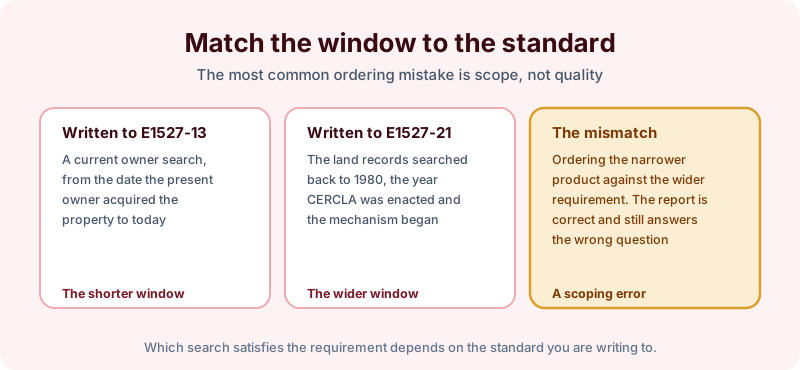
Which search satisfies the requirement depends on the ASTM standard the assessment is written to. An assessment written to E1527-21 needs the land records searched back to 1980, which is what the 1980 lien and AUL search is built for. The current owner environmental lien search covers the shorter window that E1527-13 used, and our comparison of the two standards sets the difference out in full. Ordering the narrower product against the wider requirement produces a report that is entirely correct and still does not answer the question asked of it.
What comes back and how it is used
A finished report carries three things worth knowing about before you order one.
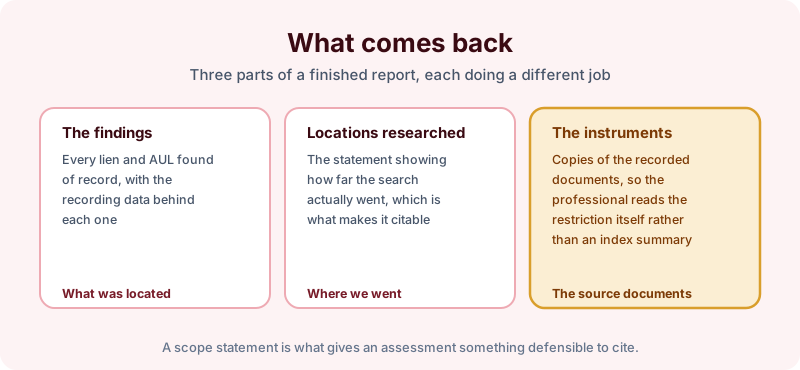
The findings, meaning every lien and AUL found of record. The locations researched, which is the statement telling a reviewer how far the search actually went. And copies of the instruments, so the professional is reading the restriction itself rather than an index summary. Those become an exhibit in the assessment, and the sample reports show the finished shape.
Who is responsible for what
Worth knowing that the standard assigns some inquiries to the user of the report rather than to the environmental professional, things like specialized knowledge of the property and the relationship between the purchase price and fair market value. Those are not questions an abstractor can research on anyone’s behalf. Whether a completed inquiry supports any particular position on liability is a legal question rather than a records question, and it belongs with counsel and the environmental professional rather than with the search.
The takeaway
All Appropriate Inquiries is a bundle of separate investigations, and a lien and AUL search is the land records piece of it. Getting that piece right is mostly a matter of matching the search window to the standard the assessment is written to, then reading what came back rather than treating a clean report as a clean site. Start the order online, or send us the property details and we will tell you which window fits the standard before anything is ordered.