

· AFX Research
Activity and Use Limitations, What They Are and How to Read One
The forms an AUL takes in the land records, why a recorded one is written to bind the owners who come after it, and the four things worth pulling out of the instrument itself.
Table of Contents
Activity and Use Limitations come up in almost every conversation about E1527-21, usually as three letters inside a sentence about what a search has to cover. Far fewer get as far as what an AUL is once you are holding one. This is a plain account of the instrument, written by the people who pull them out of county records, because the document governs how a property can be used long after the cleanup that produced it is finished.
What an AUL actually does
An AUL limits how land may be used, or requires someone to keep doing something, or both. The usual pairing is a prohibition and a duty. Residential occupancy is barred, groundwater may not be drawn for drinking, and the asphalt cap over a former tank field must stay intact and be inspected on schedule.
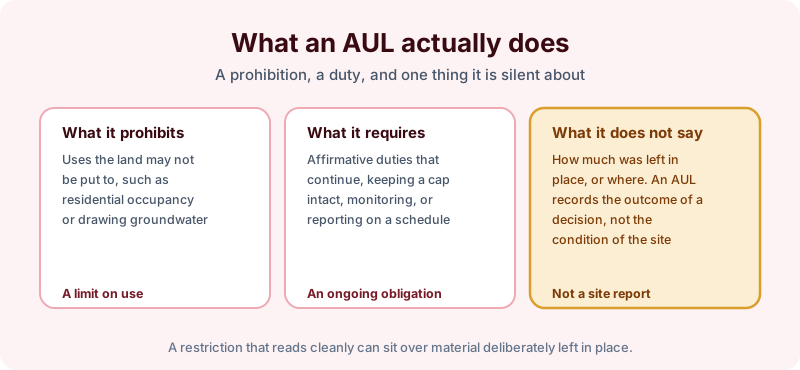
What an AUL does not do is describe the contamination. It records the outcome of a decision rather than the condition of a site, and it rarely quantifies what was left in place or where. A restriction that reads cleanly can sit over material deliberately left above residential standards, which is usually why it exists at all. Reading one as reassurance runs the logic backwards.
How it reaches the record
There is no single national instrument, so an AUL arrives in the land records by more than one route.
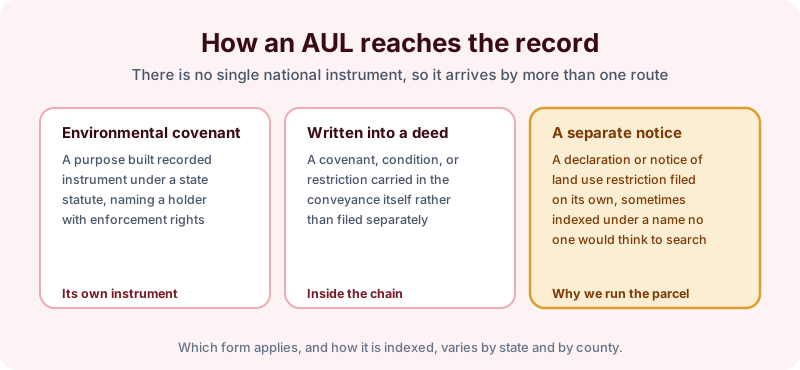
Many states have adopted a version of the Uniform Environmental Covenants Act, which creates a purpose built recorded instrument naming an agency or other holder with the right to enforce it. Elsewhere, and often alongside it, the restriction is written into a deed as a covenant or condition, or recorded on its own as a declaration or notice of land use restriction. Some obligations sit in a consent order or a permit, and whether that underlying document ever reaches the land records varies. The practical consequence is that an AUL may be indexed under a party no one would think to search for, which is one reason a search walks the parcel and the chain of title rather than running a keyword.
Why it follows the property
The point of recording is durability. A restriction binding only the owner who agreed to it would expire at the next closing, defeating the remedy it was written to protect.
A properly recorded covenant is generally drafted to run with the land and bind later owners, though what makes it enforceable, and against whom, is a question of state law rather than something a search resolves. For a buyer the practical effect is the part that matters. The restriction was negotiated by someone else, in a matter you were not party to, and it arrives attached to the parcel. Our post on what a search cannot tell you covers the companion point, that finding none is not the same as there being none.
Four things to pull from the instrument
Index lines summarize. The recorded document is where the substance sits, and four items are worth locating before anyone forms a view.
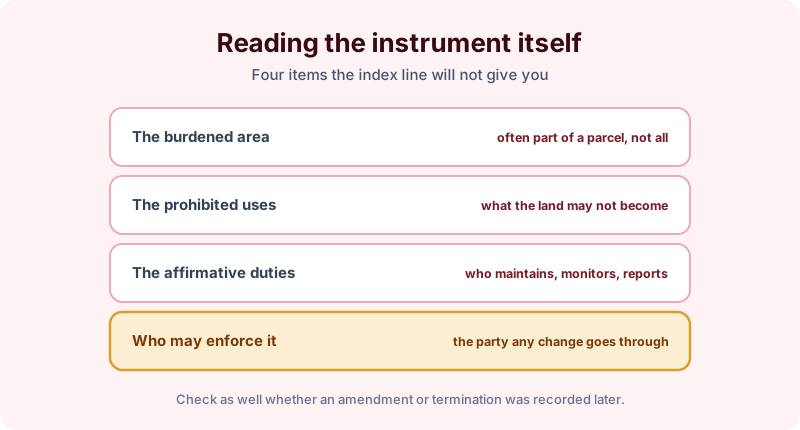
Start with the burdened area, because an AUL frequently covers part of a parcel rather than all of it, with the legal description drawn to the remediation footprint instead of the property line. Then the prohibited uses, then the affirmative duties and who carries them, since maintenance and monitoring are what turn into cost. Last, the party holding enforcement rights, who has to be involved if anyone wants the restriction modified or released. Check as well whether an amendment or termination was recorded later, because these instruments do get revised.
Where the review requirement comes from
The volume of AUL requests traces to the standard itself. E1527-21 pushed the lien and AUL review back to 1980, and our comparison of the two standards sets out how that changed the scope against E1527-13. The 1980 lien and AUL search is built for that window, while the current owner environmental lien search covers the shorter one. Where a prior title policy is already in hand there is a second accepted route, which our post on using a previous policy walks through.
The takeaway
An AUL is a recorded restriction that limits use, usually imposes a continuing duty, and is written to stay with the land long after the people who negotiated it have gone. It is not a description of what is in the ground, and whether one amounts to a Recognized Environmental Condition, a controlled REC, or a historical one is decided in the assessment rather than in the search report. What a search gives you is every AUL found of record in the locations searched, with the instruments attached. Start the order online, or send us the property details and we will tell you which window fits the standard your assessment is written to.