

· AFX Research
Data Gaps in an Environmental Lien Search, and What Creates Them
The difference between finding nothing and being unable to look, the five conditions that produce a gap in records research, and who decides whether one is significant.
Table of Contents
E1527-21 asks more of an assessment on the subject of data gaps than the standard it replaced, and a fair share of that lands on the records search. The distinction it turns on is easy to state and easy to lose. Finding nothing and being unable to look are different outcomes. This is an account of which conditions produce the second one, what gets done about them, and where the judgment sits.
Finding nothing is not a gap
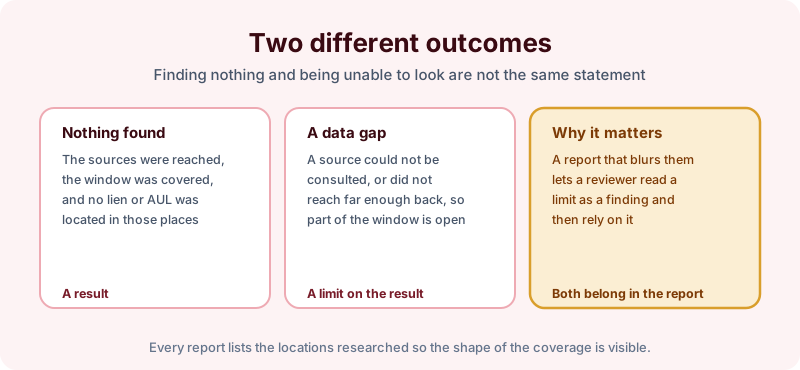
A clean result means the sources were reached, the window was covered, and no lien or Activity and Use Limitation was located in the places searched. A data gap means something interrupted that. A source could not be consulted, or did not reach far enough back, so part of the window has no answer rather than a negative one. A report that blurs the two is worse than one that finds nothing, because a reviewer reads a limit as a result and then relies on it. Our post on what a search cannot tell you covers the general shape of that boundary.
What produces one in records work
Gaps are not exotic. Most trace to the physical condition of a county’s records rather than to anything about the property itself.
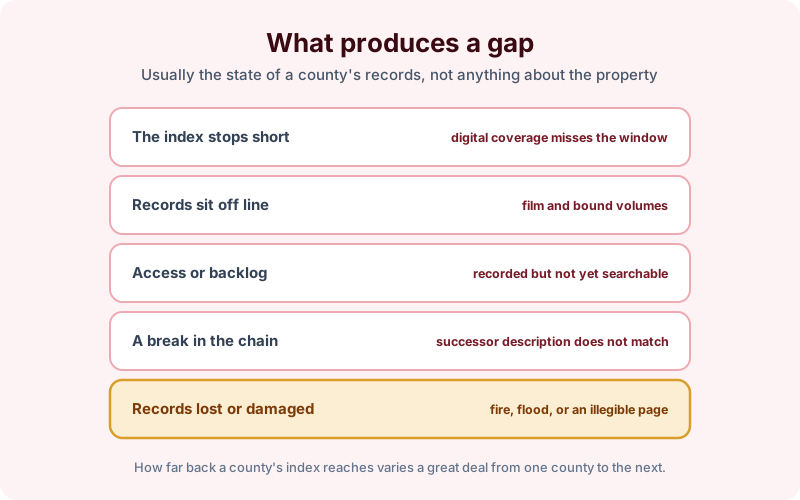
The most common is reach. A county’s digital index may begin in 1985 or 1992, which becomes a problem when the assessment is written to E1527-21 and needs the land records covered back to 1980. Below that line the material still exists on microfilm or in bound volumes, which is slower rather than impossible. Add office access, indexing backlogs where a filing is recorded but not yet searchable, a break in the chain where a successor description does not obviously match its predecessor, and the occasional county where a fire or a flood took a range of books out of the record permanently.
Why the report says so
The alternative to documenting a gap is producing a report that reads complete and is not, which is the failure worth designing against. It is also the reason every report lists the locations researched. That statement is what lets a reviewer see the shape of the coverage rather than infer it, and it is what makes the exhibit defensible to cite. The sample reports show how it reads in a finished document.
Significant is the professional’s word
E1527-21 is specifically concerned with gaps that are significant, and that adjective carries real weight. Whether a gap is significant depends on what the assessment is trying to conclude, what the other lines of inquiry turned up, and what the professional already knows about the site. None of that is visible from inside a records search. We document the gap and its extent. The environmental professional decides what it means, the same division that governs whether a finding is a Recognized Environmental Condition. Our post on where the search fits in All Appropriate Inquiries sets that division out in full.
What closes one
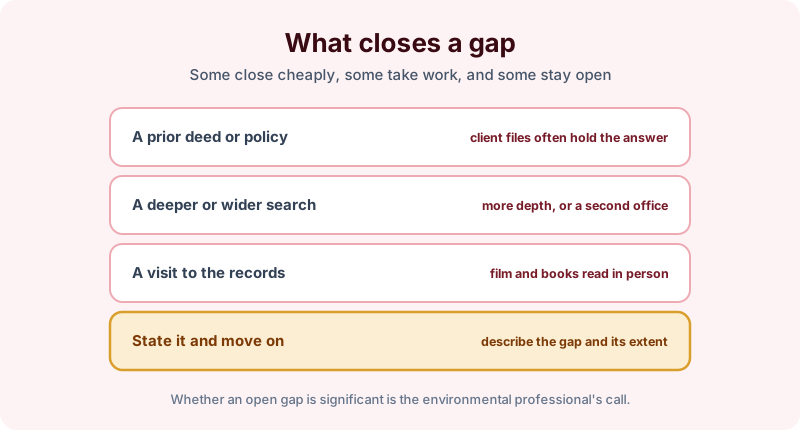
Some gaps close cheaply. A prior deed or a previous title policy sitting in the client file often supplies exactly what the index will not, which is why those documents are worth sending at intake rather than holding back. Others close with more work, a wider search across a second office or a researcher reading film in person. And some do not close at all, in which case the honest move is to state the gap, describe how far it extends, and let it be weighed alongside everything else in the assessment.
The takeaway
A data gap is a statement about the search rather than about the property, and keeping it distinct from a clean result is most of the discipline. Reach, format, access, chain breaks, and lost records are what produce them, client documents close a good number of them, and whether an open one is significant belongs to the assessment rather than to the abstractor. Start the order online, or send us the property details and we will tell you what the index in that county actually supports before anything is ordered.