

· AFX Research
Following the Land When a Parcel Has Been Split or Combined
Why a parcel number is a poor handle on a long window, what a split or a combination leaves in the record, and the four documents that let a researcher pin the shape down.
Table of Contents
An order arrives with a parcel number, and that number describes the property as it exists this year. The search behind it has to cover the land as it existed for decades, and land is not obliged to hold still. Parcels get split, combined, and re-described, and each of those events leaves the current number a weaker guide to the history than it looks.
The parcel is not a fixed thing
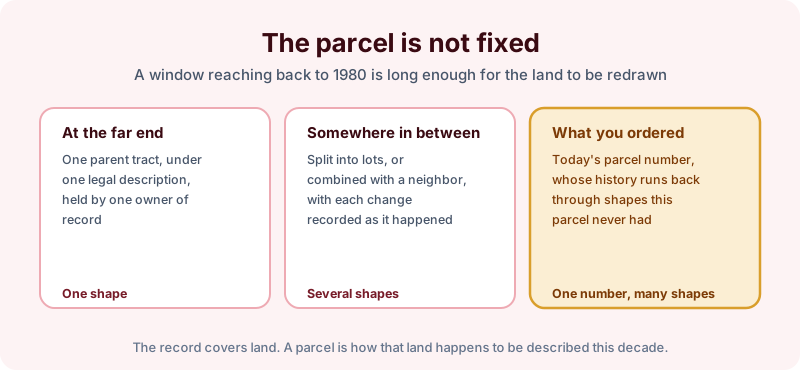
A window reaching back to 1980 is long enough for a single tract to become a subdivision, or for three lots to become one industrial site. The record covers land, not parcel numbers. A number is an administrative convenience that a county assigns, retires, and reassigns as the ground is redrawn, which is why our post on identifying the property treats the legal description as the thing that actually matches what the recorder holds.
What a split leaves behind
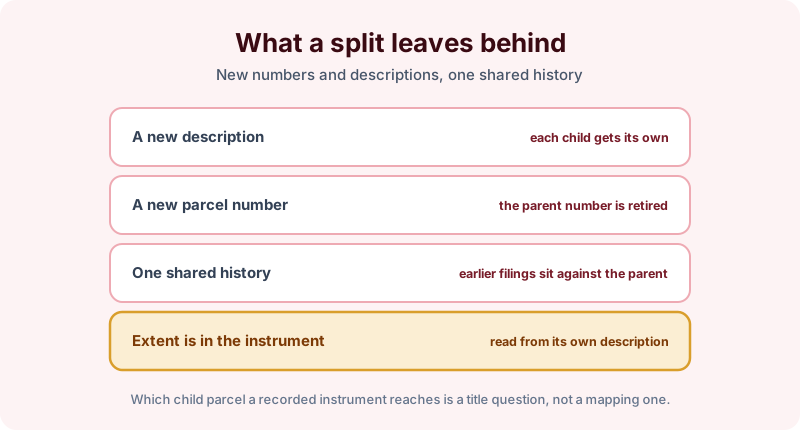
When a tract is divided, each piece takes a new description and usually a new number, and the parent number is retired. Everything recorded before that point was recorded against the parent, so the pre-split history is shared by every piece that came out of it. Whether a particular filing reaches a particular child parcel is read from the instrument’s own description rather than assumed from the family tree. That matters especially for Activity and Use Limitations, which are often drawn to a remediation footprint rather than to a property line, a point our post on reading an AUL develops.
What a combination does
Assemblage runs the same logic in reverse and is easier to get wrong. A site that reads as one parcel today may be four former lots, each with its own chain, its own former owners, and its own filings. A lien recorded against one of those lots in 1991 burdens the land that lot consisted of, not automatically the whole of what was later assembled around it. A search that treats the assembled parcel as a single history will miss three quarters of the names it should have run. It also tends to miss the more interesting half of the history, since the former lot that held the machine shop is rarely the one whose name sits on the current deed.
Why the description leads
All of this is why the work follows the description and the chain rather than the number. The chain of title is what reveals that a parcel was carved out of something larger in 1997, and the description is what says how much of the parent it took. Where a county maintains a parent and child relationship in its indexes that makes the tracing quicker, but the practice varies, and plenty of counties leave it to be reconstructed from the deeds themselves. A successor description that does not obviously match its predecessor gets documented as a break rather than guessed at, which is the honest handling even when it is the slower one.
What pins the shape down
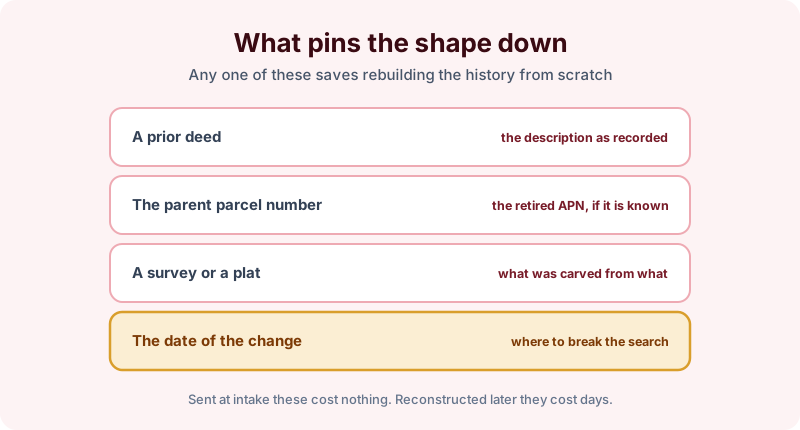
Four things make this fast when they are available at intake. A prior deed carries the description in the form the recorder holds it. The retired parent number, if anyone knows it, is a direct handle on the earlier material. A survey or a plat shows what was carved from what. And the date of the change tells the researcher where the search has to break and pick up a different description. None of them is required, and any one of them saves reconstructing the shape from scratch.
The takeaway
A parcel number is a snapshot, and an environmental search covers a span long enough for the snapshot to be misleading. Splits leave a shared history behind them, combinations hide several histories inside one, and both are handled by following the recorded descriptions rather than the current number. A report describes every lien and AUL found of record against the land and names actually searched. Start the order online, or send us the parcel number and any prior deed and we will tell you what the history behind that parcel looks like before anything is ordered.