

· AFX Research
Foreclosures and Tax Sales in an Environmental Chain of Title
The three transfers that are not ordinary sales, why the grantor is rarely who you expect, and why a forced transfer never shortens the window a search has to cover.
Table of Contents
Most conveyances in a chain of title are a sale between two willing parties, and they read that way. A few are not, and those are the ones that change how the chain has to be read. A foreclosure, a tax sale, or a deed in lieu puts a transfer in the record that no ordinary transaction would produce, and each one has consequences for a search that reaches back decades.
Not every conveyance is a sale
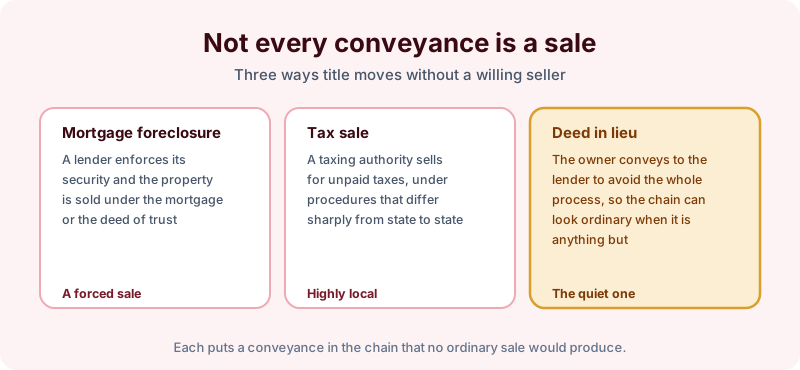
In a foreclosure a lender enforces its security and the property is sold under the mortgage or the deed of trust. In a tax sale a taxing authority sells for unpaid taxes, under procedures that differ sharply from one state to the next. A deed in lieu is the quiet version, where the owner conveys to the lender to avoid the process entirely, which leaves a chain that can look like an arm’s length sale and is not one.
The grantor is rarely who you expect
This is the practical difference a researcher meets first. In an ordinary sale the seller signs the deed, so the name on the instrument is the name of the owner who held title. In a forced transfer the instrument is frequently executed by a sheriff, a trustee, a referee, or a tax collector acting under an order or a power of sale. The former owner may never appear as grantor at all. Walking the chain by names alone, a researcher can lose the thread exactly where the ownership actually changed, which is one of the ways the grantor and grantee index stops being a simple ladder.
What clears and what survives
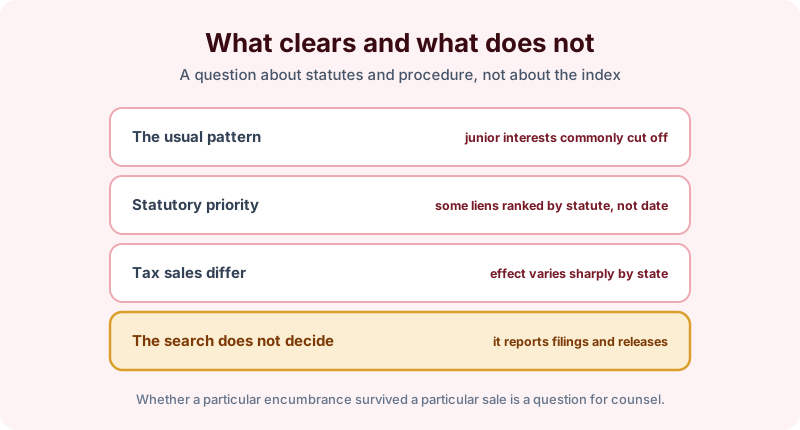
The question everyone asks is whether the sale wiped the slate. The general pattern is that foreclosure of a senior interest cuts off interests junior to it, but that is a starting point rather than an answer. Some environmental liens are ranked by the statute that created them rather than by recording date, a point our post on how a lien arises and is released sets out. Tax sale effects vary enormously by state. Whether a specific encumbrance survived a specific sale is a legal question, and what a search contributes is the recorded picture, every filing and every release found of record, for counsel to work from.
The window does not reset
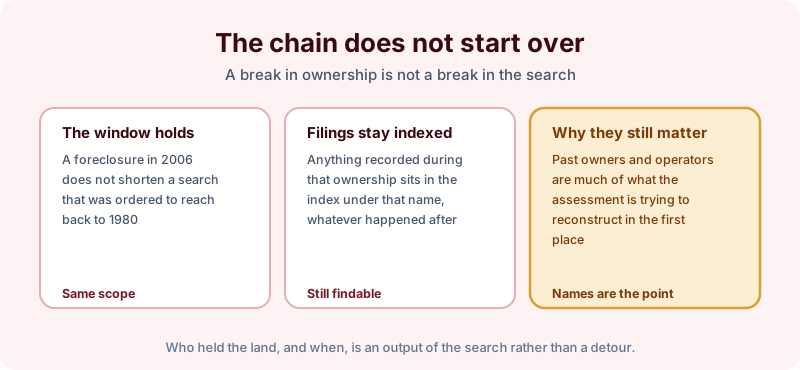
A forced transfer sometimes gets treated as a clean break, as though history before it stopped counting. It does not work that way. A search ordered to reach 1980 still reaches 1980. Anything recorded during a prior ownership stays in the index under that owner’s name whatever happened afterward, and the prior owners and operators are much of what the assessment is trying to reconstruct in the first place. A break in ownership is not a break in the search.
What it means for scoping
Two practical notes. A property with a foreclosure or a tax sale in its recent history often takes longer, because the chain of title has to be established across a transfer where the usual name to name continuity is absent. And if you already know one of these sits in the chain, saying so at intake is genuinely useful, since it tells a researcher where the awkward part of the work is before they meet it. Tax sales in some states also carry a redemption period, during which the outcome is not yet settled, which is one more reason the date of a sale matters as much as the fact of it.
The takeaway
Foreclosures, tax sales, and deeds in lieu each put a conveyance in the chain that behaves differently from a sale. The grantor is often an officer rather than the owner, what an encumbrance survived is a question of statute and procedure rather than of the index, and none of it shortens the window the search was ordered to cover. Start the order online, or send us the property details and we will tell you what the chain in that county looks like before anything is ordered.