

· AFX Research
How an Environmental Lien Arises and How One Gets Released
The federal and state routes an environmental lien takes into the land records, why the recording date alone may not settle its priority, and why the release is a separate document.
Table of Contents
An environmental lien is the part of this work people assume they already understand, usually by analogy to a mortgage or a tax lien. The analogy holds for the recording mechanics and comes apart almost everywhere else. This is a plain account of how one comes into existence, what it attaches to, and how it eventually leaves the record, written by the people who go looking for both halves of that history.
Two sources, federal and state
Environmental liens do not come from a single statute, which is the first thing that makes them awkward to generalize about.
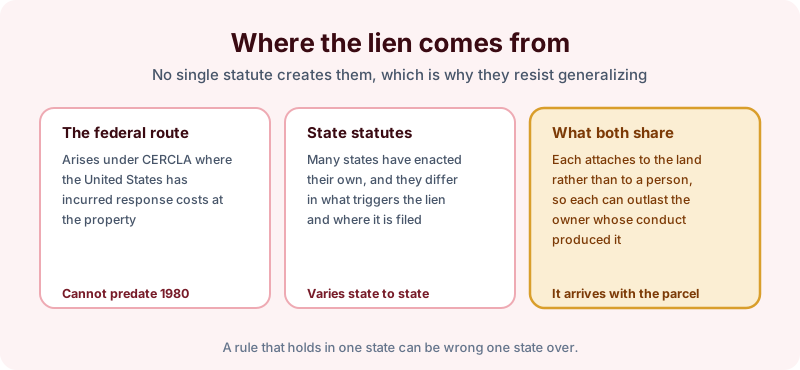
The federal route runs through CERCLA, where the United States may assert a lien on property at which it has incurred response costs. Because the statute created that mechanism in 1980, no lien arising under it predates that year, which is the reason the 1980 search window exists at all. Separately, many states have enacted environmental lien statutes of their own, and those differ in what triggers the lien, what it secures, and where it has to be filed to bind anyone. A rule that holds in one state can be wrong one state over, so the useful question is always which statute governs this parcel.
What it attaches to
The lien runs against the land rather than the person. That is the feature that makes it matter to a buyer. A liability attaching to an owner personally would stay that owner’s problem. A lien recorded against the parcel arrives with the parcel, which is why it belongs in a due diligence file rather than in the seller’s. Our post on reading an Activity and Use Limitation covers the companion instrument, which follows the property for the same reason by a different route.
Priority varies more than people expect
Most encumbrances follow a rule simple enough to state in one line. First recorded, first in right.
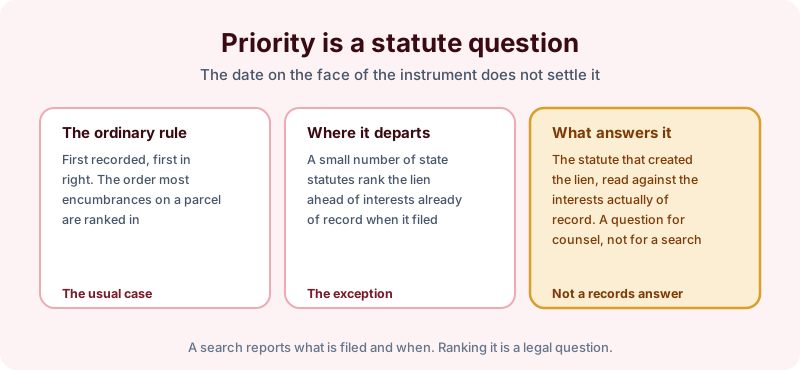
Some state environmental lien statutes depart from that, and a small number rank the lien ahead of interests that were already of record when it was filed. Whether a given statute does this, how far it reaches, and what exceptions it carries are questions about that statute rather than about the search. The consequence for a reviewer is worth saying plainly. The date on the face of the instrument does not by itself tell you where the lien sits against a mortgage, and working that out is a question for counsel.
How a lien leaves the record
Liens do get resolved. What they do not do is disappear.
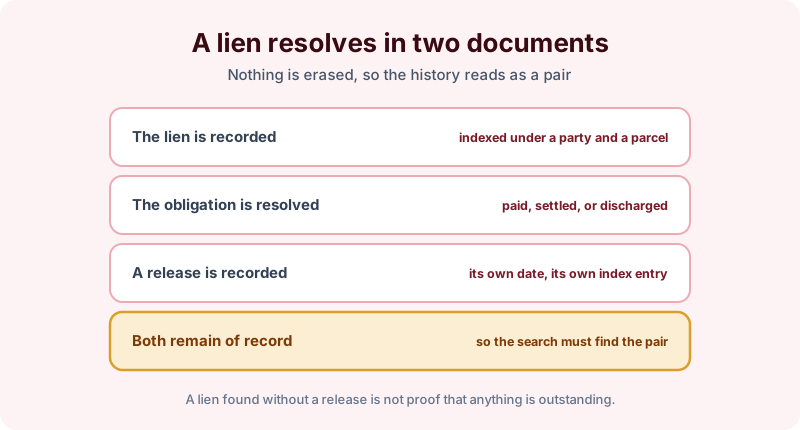
When the underlying obligation is satisfied, the release is recorded as its own instrument, carrying its own date and its own index entry. The original filing stays where it was. That leaves two documents describing one matter, and a search has to locate both to describe the situation accurately. It also means a lien found without a release is not proof that anything is outstanding, because a release is sometimes indexed under a party the original filing never named, or recorded in an office the first document never touched.
What this means for the search
Two things follow for how the work is actually done. The search walks the parcel and the chain rather than one name, since a filing and its release can sit under different parties. And the report describes what was found in the locations searched instead of announcing that a parcel is clear, because an empty result is not proof that nothing exists. The sample reports show how that reads in a finished document.
The takeaway
An environmental lien can arise federally under CERCLA or under a state statute, it attaches to the property rather than to an owner, and its priority is a question about the governing statute rather than about the recording date. When one is resolved the release records separately and both documents remain, so the honest answer about any parcel is every lien and release found of record in the places searched. Start the order online, or send us the property details and we will tell you what a search of that scope would cover before anything is ordered.