

· AFX Research
Why the Owner Names Behind a Search Are Harder Than They Look
The five ways one owner of a parcel ends up under several names, how a lien filed under a former name stays hidden, and what to send at intake so the list is complete.
Table of Contents
Ask what an environmental lien search runs against and the obvious answer is the property. That is half right. Older filings in most counties are reachable only through the names of the people and companies that held title at the time, which makes the name list a piece of research in its own right. It is also the part most likely to be quietly incomplete.
One owner, several names
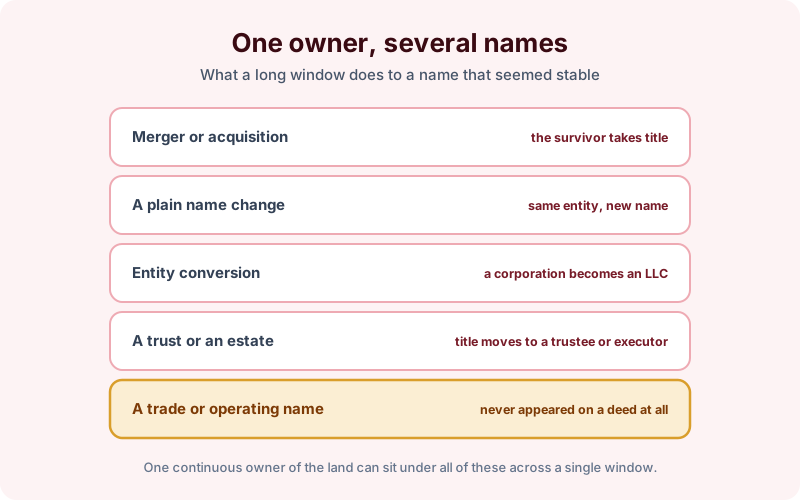
A parcel held continuously by what everyone would call the same business can sit under a series of different names across a window reaching back to 1980. Companies merge and the survivor takes title. Entities change names without changing anything else about themselves. A corporation converts to an LLC. Title moves to a trustee or passes through an estate on a death. And separately from all of that, the business operating on the site may have traded under a name that never appeared on a deed at all. This is one reason the chain of title is ordered with the search rather than after it.
Why a filing hides behind a former name
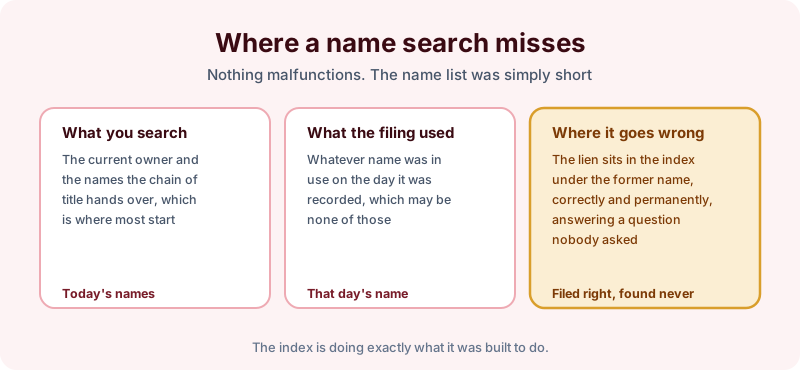
Recording works on the name in use the day the instrument was filed. A lien recorded in 1994 against a company that changed names in 2003 stays indexed under the 1994 name, correctly and permanently. Search only the names the current chain hands you and that filing sits exactly where it belongs, answering a question nobody asked. Nothing has malfunctioned. The index is doing what it was built to do, and the name list was short.
Operators are not always owners
There is a second version of this that catches people out. The party whose activity produced a condition is not necessarily the party on the deed. A tenant running the plating line, a contract operator, a subsidiary occupying a parcel its parent holds. Where a filing names that party rather than the fee owner, care with the ownership chain will not surface it, because the ownership chain never contained the name. It is one of the reasons the inquiry does not rest on land records alone.
Where a parcel search helps and where it does not
Some counties maintain a tract or parcel index alongside the name index, and where one exists it catches filings regardless of which name they carry. That is a real help and it is not universal. Coverage varies by county and, within a county, usually by era, since a parcel based system reaches back only as far as it was built. Our post on the grantor and grantee index explains why the older material stays name bound, and the one on identifying the parcel covers the description side of the same problem. A search uses whatever a given county actually supports, which is why we ask about the county early.
What helps at intake
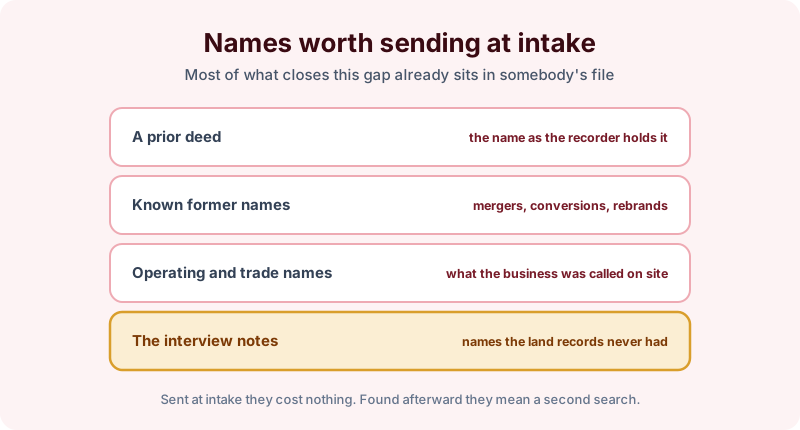
Most of what closes this gap is already sitting in somebody’s file. A prior deed carries the name in exactly the form the recorder holds it. Known former names, merger history, and rebrands are usually common knowledge inside the client organization and invisible from outside it. Operating and trade names used on the site matter for the same reason. And the professional’s interviews frequently surface a name the land records never had. Sent at intake those cost nothing. Discovered after the report lands they mean a second search.
The takeaway
A name is not a stable handle on an owner across a long window, and an environmental lien search is only as complete as the list of names it ran. Mergers, conversions, estates, and trade names all break the assumption that today’s owner name reaches yesterday’s filings, and a report describes every lien and AUL found of record under the names and parcels actually searched. Start the order online, or send us the details and any former names and we will tell you what that county’s indexes support before anything is ordered.